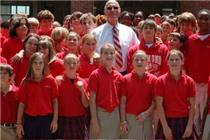
Dr. Barks and Hammond students
photo by Hammond School
After 17 years away, former Baylor School headmaster Dr. Herb Barks Jr. is back home in Chattanooga. Following his retirement as headmaster of the Hammond School in Columbia, S.C., this spring, Dr. Barks and his wife, Carol, moved into their Peter Pan Road home on Lookout Mountain in June.
Although his wife’s recent diagnosis of leukemia and his recent discovery that he has a treatable form of prostate cancer have focused their current concerns primarily on getting well, Dr. Barks is still looking forward to becoming reacquainted with the Scenic City and old friends.
“It feels great to be back in Chattanooga,” he said.
Definitely retired, he has no current plans to serve Baylor in any official or unofficial capacity, although he would be delighted to help in some way if needed, he said. He has recently been writing a book about growing old and may do some more writing.
When Dr. and Mrs. Barks were thinking about where to retire, they thought Chattanooga might be more ideal than some place like Murphy, N.C., where they have a vacation home. Not only is Chattanooga their former home, Dr. Barks said it also has any needed medical facilities.
That they ended up on Lookout came about somewhat by accident, however. “We were really looking in Riverview and then this house came up for sale,” he said.
Columbia, S.C., was also an unexpected place to move when he decided to step down as headmaster at Baylor in 1988. He was making tentative plans to help Baylor as a fund-raiser and development consultant during the following school year. Instead, he ended up going to Israel.
During that year away from students, he realized he missed working with young people. So, he was able to secure the headmaster position at Hammond. Hammond was a school that had been founded in 1967, when a number of private schools in the South were being started after integration began, Dr. Barks said. When Dr. Barks arrived in 1989, the school had serious financial problems and only 466 students.
Although most successful headmasters’ resumes usually include going from a younger, smaller and still developing school like Hammond to a tradition-rich institution like Baylor, Dr. Barks – who is remembered for his dynamic presence and personality at Baylor -- took the opposite approach. But, by all accounts, he left a positive mark on both places.
“Baylor was fun and we had a great time and plenty of resources,” he said. “At Hammond, we had no resources and spent 17 years rebuilding the school. I had to think all the time about money.”
But the school did have potential, and Dr. Barks hinted that he especially had fun helping mold and shape it. Today, it has more than 1,000 students in grades K-12 and is the largest independent school in South Carolina.
Another evidence of Dr. Barks’ mark on Hammond was demonstrated literally on May 4, at the dedication of the school’s newest building -- Barks Hall – named for both Dr. and Mrs. Barks. The whole student body turned out for the event, and the featured speaker was a fellow Murphy, N.C., neighbor named Bill Curry, the former college football coach and current Baylor staff member.
“It is always a little humbling when something like that happens because so many people are involved, but Carol and I loved having the building dedicated to us,” he said.
Baylor, of course, already has a Barks Hall, which was dedicated in 1961 in honor of his highly respected and well-liked father. Dr. Barks Sr. had served as headmaster from 1929-64, leading Baylor through the Great Depression, World War II and a polio outbreak in 1948.
Dr. Barks Jr., who was reared on the Baylor School campus and graduated in 1951, initially was a minister, serving at First Presbyterian Church in Chattanooga and at a number of other Presbyterian churches all over the country.
He had always enjoyed working with young people, he said, including while teaching for a year at Westminster School in Atlanta. So, he gladly accepted the opportunity to become headmaster at Baylor when he was named in 1970. He began serving several months later.
In 1971, Baylor dropped its military curriculum, as McCallie School had done the year before. That year also saw the renewal of the Baylor-McCallie football game for the first time since 1940.
Although Dr. Barks’ greatest legacy may be that Baylor became a coed school in 1985, while he was there, that is not the Baylor accomplishment of which he is most proud.
“The first thing is that I thought we built a great faculty,” he said. “The other thing was that I brought the first black student to Baylor. That was part of the agreement in my hiring.”
He said that coeducation actually was not his idea, that it had been part of a long-range study done in which numerous Baylor people participated. “But I thought it was wonderful,” he said.
He was also known as an innovator at Baylor, developing such new programs as the Walkabout outdoors curriculum and the senior rafting and hiking trip to the area around the Chattooga River in Northeast Georgia.
At Hammond, his innovative ideas continued. He also had a wilderness program and took a senior trip to the same place Baylor does. He also took the junior class to Belize every year for about 11 days.
Dr. Barks has also brought the world to Hammond. He developed a program in which the school studied a country each year and planned some of the academic curriculum around it. Last year, South Africa was studied, and this year, the Czech Republic is the featured country. Three faculty members are chosen by a drawing to visit the country before the year starts.
Besides an emphasis on the outdoors and travel, Baylor and Hammond are similar in that they both have a strong and healthy sense of community, Dr. Barks said.
And in a few cases, they had some of the same people in those communities. Among the former Baylor staff members and students who have been on the staff at Hammond at some point since Dr. Barks arrived have been Amy Stone, Scott Wilson, Joe Schmidt, Jimmy Braddock, Rich Edwards, Chris Angel and Ray Deering.
“I stole them,” Dr. Barks said with a laugh. “I talked them into coming. We were just struggling with building a school and they got excited about working together.”
And now Chattanooga has secured Dr. Barks back.
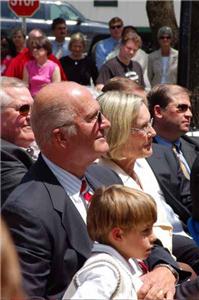
Dr. Herb and Carol Barks at building dedication
photo by Hammond School