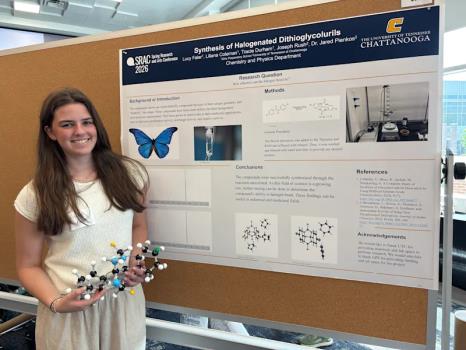
Lucy Faler
For students at Girls Preparatory School, learning doesn’t stop at the classroom door. Through a unique partnership with the University of Tennessee at Chattanooga arranged by Tracie Marlin Durham ’72, a GPS science teacher and alumna of both GPS and UTC, students like Liliana Coleman ’27 and Lucy Faler ’26 are stepping into real college labs, gaining hands-on research experience that is rare at the high school level.
The partnership connects GPS students with undergraduate mentors and faculty in UTC’s chemistry department, offering a window into the world of collegiate research. For Lucy, a senior who joined the program last year, that experience has been transformative.
“I’ve always been kind of intimidated by research,” she said. “But this has been a really awesome way to learn what a college lab is actually like, and realize that I can do it.”
Lucy began by learning foundational lab techniques before diving into a research project this year focused on synthesizing chemical compounds. Her work included conducting reactions, analyzing results using advanced tools like nuclear magnetic resonance spectroscopy, and recently presenting her findings at the UTC Spring Research and Arts Symposium.
“It was really cool to be able to walk people through the process, from creating the compound to analyzing the data,” she said. “And even explain it to people who weren’t in science at all.”
That ability to communicate complex ideas clearly was shaped in part by her mentorship experience. Working closely with Joseph Rush, a UTC biochemistry major, Lucy gained both technical skills and confidence—skills she’ll carry with her to Davidson College this fall, where she plans to pursue a pre-med track.
“I feel way less intimidated going into college research now,” she said. “It’s given me a huge head start.”
For Liliana, a junior just beginning her journey in the program this semester, the experience is already expanding her understanding of science beyond textbooks.
“In class, you’re mostly learning formulas and solving problems,” she said. “This is actually working with chemicals and seeing how research happens in real life.”
Meeting weekly after school—sometimes here at GPS and others on UTC’s campus—Liliana and Lucy have been working alongside Joseph and his professor, Dr. Pienkos, gaining exposure to specialized equipment and techniques not typically available in high school settings. The partnership also allows students to contribute to ongoing research projects, with opportunities to present their work and even be acknowledged in published studies.
Liliana, who is interested in public and environmental health, sees the program as an important foundation for her future.
“Having these skills going into college will help me get more research opportunities,” she said. “It’s a really valuable experience.”
Participation requires both academic preparation—students must have completed Honors Chemistry—and the flexibility to commit time after school. But for those who can, the payoff is significant.
Both students emphasized how the program demystifies the research process and opens doors to future possibilities.
“It’s not a huge time commitment, but it’s such a meaningful opportunity,” Lucy said. “I always tell younger students they should really consider it.”
As GPS continues to expand opportunities like the UTC partnership, students are not just learning about science, they’re actively contributing to it.